Susskind Black Hole War Pdf
✏Book Title: The Little Book of Black Holes✏Author: Steven S. Gubser✏Publisher: Princeton University Press✏Release Date: 2017-09-25✏Pages: 200✏ISBN: 290✏Available Language: English, Spanish, And French✏The Little Book of Black Holes Book Summary: Dive into a mind-bending exploration of the physics of black holes Black holes, predicted by Albert Einstein’s general theory of relativity more than a century ago, have long intrigued scientists and the public with their bizarre and fantastical properties. Although Einstein understood that black holes were mathematical solutions to his equations, he never accepted their physical reality—a viewpoint many shared. This all changed in the 1960s and 1970s, when a deeper conceptual understanding of black holes developed just as new observations revealed the existence of quasars and X-ray binary star systems, whose mysterious properties could be explained by the presence of black holes.
Black holes have since been the subject of intense research—and the physics governing how they behave and affect their surroundings is stranger and more mind-bending than any fiction. After introducing the basics of the special and general theories of relativity, this book describes black holes both as astrophysical objects and theoretical “laboratories” in which physicists can test their understanding of gravitational, quantum, and thermal physics. From Schwarzschild black holes to rotating and colliding black holes, and from gravitational radiation to Hawking radiation and information loss, Steven Gubser and Frans Pretorius use creative thought experiments and analogies to explain their subject accessibly. They also describe the decades-long quest to observe the universe in gravitational waves, which recently resulted in the LIGO observatories’ detection of the distinctive gravitational wave “chirp” of two colliding black holes—the first direct observation of black holes’ existence. The Little Book of Black Holes takes readers deep into the mysterious heart of the subject, offering rare clarity of insight into the physics that makes black holes simple yet destructive manifestations of geometric destiny.
✏Book Title: The Mathematical Theory of Black Holes✏Author: Subrahmanyan Chandrasekhar✏Publisher: Oxford University Press✏Release Date: 1998✏Pages: 646✏ISBN: ✏Available Language: English, Spanish, And French✏The Mathematical Theory of Black Holes Book Summary: 'The theory of black holes is the most simple consequence of Einstein's relativity theory. Dealing with relativity theory, this book details one of the most beautiful areas of mathematical physics; the theory of black holes. It represents a personal testament to the work of the author, who spent several years working-out the subject matter.' ✏Book Title: The Little Book of String Theory✏Author: Steven S. Gubser✏Publisher: Princeton University Press✏Release Date: 2010-02-08✏Pages: 184✏ISBN: ✏Available Language: English, Spanish, And French✏The Little Book of String Theory Book Summary: The Little Book of String Theory offers a short, accessible, and entertaining introduction to one of the most talked-about areas of physics today.
String theory has been called the 'theory of everything.' It seeks to describe all the fundamental forces of nature. It encompasses gravity and quantum mechanics in one unifying theory.
But it is unproven and fraught with controversy. After reading this book, you'll be able to draw your own conclusions about string theory. Steve Gubser begins by explaining Einstein's famous equation E = mc2, quantum mechanics, and black holes. He then gives readers a crash course in string theory and the core ideas behind it. In plain English and with a minimum of mathematics, Gubser covers strings, branes, string dualities, extra dimensions, curved spacetime, quantum fluctuations, symmetry, and supersymmetry.
He describes efforts to link string theory to experimental physics and uses analogies that nonscientists can understand. How does Chopin's Fantasie-Impromptu relate to quantum mechanics?
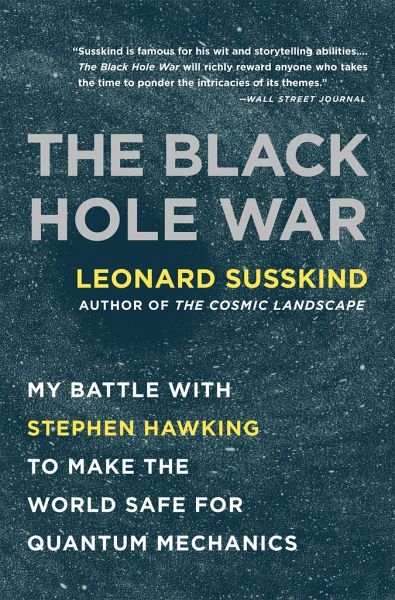
What would it be like to fall into a black hole? Why is dancing a waltz similar to contemplating a string duality? Find out in the pages of this book. The Little Book of String Theory is the essential, most up-to-date beginner's guide to this elegant, multidimensional field of physics. ✏Book Title: The Black Hole War✏Author: Leonard Susskind✏Publisher: Hachette UK✏Release Date: 2008-07-07✏Pages: 480✏ISBN: 698✏Available Language: English, Spanish, And French✏The Black Hole War Book Summary: What happens when something is sucked into a black hole? Does it disappear?
Three decades ago, a young physicist named Stephen Hawking claimed it did-and in doing so put at risk everything we know about physics and the fundamental laws of the universe. Most scientists didn't recognize the import of Hawking's claims, but Leonard Susskind and Gerard t'Hooft realized the threat, and responded with a counterattack that changed the course of physics. THE BLACK HOLE WAR is the thrilling story of their united effort to reconcile Hawking's revolutionary theories of black holes with their own sense of reality-effort that would eventually result in Hawking admitting he was wrong, paying up, and Susskind and t'Hooft realizing that our world is a hologram projected from the outer boundaries of space. A brilliant book about modern physics, quantum mechanics, the fate of stars and the deep mysteries of black holes, Leonard Susskind's account of the Black Hole War is mind-bending and exhilarating reading. ✏Book Title: The Little Book of Maths Theorems Theories and Things✏Author: Surendra Verma✏Publisher: New Holland Publishers (AU)✏Release Date: 2008✏Pages: 169✏ISBN: 326✏Available Language: English, Spanish, And French✏The Little Book of Maths Theorems Theories and Things Book Summary: Mathematics is indeed fun as this little book testifies. This book presents a unique collection of mathematical ideas, theories, theorems, conjectures, rules, facts, equations, formulas, paradoxes, fallacies and puzzles with short, simple and witty explanations that require no background in mathematics. ✏Book Title: The Little Book of Big Explorations✏Author: Jheni Osman✏Publisher: Michael O'Mara Books✏Release Date: 2019-11-14✏Pages:✏ISBN: 806✏Available Language: English, Spanish, And French✏The Little Book of Big Explorations Book Summary: This is a book about expedition, adventure, our thirst for knowledge and pushing the limits of human endurance.

From the navigational instruments that have led us through unknown lands, to the advanced engineering that carried us into the depths of the ocean, to the rocket science that propelled us into space, science and adventure have always been inextricably linked. Both are at the heart of everything we now know about the complex universe we find ourselves in. From the groundbreaking sea voyage in 1735 that settled the debate raging between Descartes and Newton about the shape of the earth to the balloon ride that led to the discovery of cosmic rays, we have pushed the limits of what's possible, both on our planet and beyond the clouds.
The Little Book of Big Explorations is a collection of some of the most daring and eye-opening adventures in history that have changed the way we view the world, as well as a look at what's still to be discovered. Our insatiable curiosity has driven our survival as a species and can be charted through the centuries by these incredible voyages of discovery. ✏Book Title: Black Holes Time Warps Einstein s Outrageous Legacy Commonwealth Fund Book Program✏Author: Kip Thorne✏Publisher: W. Norton & Company✏Release Date: 1995-01-17✏Pages: 624✏ISBN: 473✏Available Language: English, Spanish, And French✏Black Holes Time Warps Einstein s Outrageous Legacy Commonwealth Fund Book Program Book Summary: Winner of the 2017 Nobel Prize in Physics Ever since Albert Einstein's general theory of relativity burst upon the world in 1915 some of the most brilliant minds of our century have sought to decipher the mysteries bequeathed by that theory, a legacy so unthinkable in some respects that even Einstein himself rejected them.
Which of these bizarre phenomena, if any, can really exist in our universe? Black holes, down which anything can fall but from which nothing can return; wormholes, short spacewarps connecting regions of the cosmos; singularities, where space and time are so violently warped that time ceases to exist and space becomes a kind of foam; gravitational waves, which carry symphonic accounts of collisions of black holes billions of years ago; and time machines, for traveling backward and forward in time. Kip Thorne, along with fellow theorists Stephen Hawking and Roger Penrose, a cadre of Russians, and earlier scientists such as Oppenheimer, Wheeler and Chandrasekhar, has been in the thick of the quest to secure answers. In this masterfully written and brilliantly informed work of scientific history and explanation, Dr. Thorne, a Nobel Prize-winning physicist and the Feynman Professor of Theoretical Physics Emeritus at Caltech, leads his readers through an elegant, always human, tapestry of interlocking themes, coming finally to a uniquely informed answer to the great question: what principles control our universe and why do physicists think they know the things they think they know? Stephen Hawking's A Brief History of Time has been one of the greatest best-sellers in publishing history.
Anyone who struggled with that book will find here a more slowly paced but equally mind-stretching experience, with the added fascination of a rich historical and human component. Winner of the Phi Beta Kappa Award in Science.
Quantum Mechanics The Theoretical MinimumWelcome,you are looking at books for reading, the Quantum Mechanics The Theoretical Minimum, you will able to read or download in Pdf or ePub books and notice some of author may have lock the live reading for some of country. Therefore it need a FREE signup process to obtain the book.If it available for your country it will shown as book reader and user fully subscribe will benefit by having full access to all books.Click and join the free full access now.
From the bestselling author of The Theoretical Minimum, an accessible introduction to the math and science of quantum mechanics Quantum Mechanics is a (second) book for anyone who wants to learn how to think like a physicist. In this follow-up to the bestselling The Theoretical Minimum, physicist Leonard Susskind and data engineer Art Friedman offer a first course in the theory and associated mathematics of the strange world of quantum mechanics. Quantum Mechanics presents Susskind and Friedman's crystal-clear explanations of the principles of quantum states, uncertainty and time dependence, entanglement, and particle and wave states, among other topics. An accessible but rigorous introduction to a famously difficult topic, Quantum Mechanics provides a tool kit for amateur scientists to learn physics at their own pace. In this unconventional and stimulating primer, world-class physicist Leonard Susskind and citizen-scientist George Hrabovsky combine forces to provide a brilliant first course in modern physics. Unlike most popular physics books - which give readers a taste of what physicists know but not what they actually do - Susskind and Hrabovsky teach the skills you need to do physics yourself.
Combining crystal-clear explanations of the laws of the universe with basic exercises, the authors cover the minimum - the theoretical minimum of the title - that readers need to master in order to study more advanced topics. In a lucid, engaging style, they introduce all the key concepts, from classical mechanics to general relativity to quantum theory.
Instead of shying away from the equations and maths that are essential to any understanding of physics, The Theoretical Minimum provides a toolkit that you won't find in any other popular science book. This is the ultimate master class in modern physics.
World-class physicist and father of string theory Leonard Susskind and citizen-scientist George Hrabovsky combine forces in a primer that teaches the skills you need to do physics yourself. Combining crystal-clear explanations of the laws of the universe with basic exercises (including essential equations and maths), the authors cover the minimum that readers should master. They introduce the key concepts of modern physics, from classical mechanics to general relativity to quantum theory, and provide a practical toolkit that you won't find in any other popular science book. A funny, insightful, and self-contained guide to Einstein's relativity theory and classical field theories-including electromagnetism Physicist Leonard Susskind and data engineer Art Friedman are back. This time, they introduce readers to Einstein's special relativity and Maxwell's classical field theory. Using their typical brand of real math, enlightening drawings, and humor, Susskind and Friedman walk us through the complexities of waves, forces, and particles by exploring special relativity and electromagnetism.
It's a must-read for both devotees of the series and any armchair physicist who wants to improve their knowledge of physics' deepest truths. In The Theoretical Minimum, world-class physicist Leonard Susskind provided a brilliant first course in classical mechanics, offering readers not an oversimplified introduction but the real thing - everything you need to start doing physics, and nothing more. Now he returns with the next challenge that every aspiring physics buff must tackle: quantum mechanics. Unlike classical mechanics, quantum mechanics is not intuitive - it concerns things so small they are beyond the range of human senses. To understand quantum physics, you need to learn a whole new way of thinking, but then, Susskind reveals, you will discover that it is even more fundamental than classical mechanics. Unlike most popular physics books - which give readers a taste of what physicists know but not what they actually do - Susskind and his co-author Art Friedman teach the maths and equations that are essential to any real understanding of quantum mechanics. Combining crystal-clear explanations, witty and helpful dialogues, and basic exercises, Quantum Mechanics is, to paraphrase Einstein, as simple as possible, but no simpler.

The Black Hole War Leonard Susskind Pdf
What happens when something is sucked into a black hole? Does it disappear? Three decades ago, a young physicist named Stephen Hawking claimed it did-and in doing so put at risk everything we know about physics and the fundamental laws of the universe. Most scientists didn't recognize the import of Hawking's claims, but Leonard Susskind and Gerard t'Hooft realized the threat, and responded with a counterattack that changed the course of physics. THE BLACK HOLE WAR is the thrilling story of their united effort to reconcile Hawking's revolutionary theories of black holes with their own sense of reality-effort that would eventually result in Hawking admitting he was wrong, paying up, and Susskind and t'Hooft realizing that our world is a hologram projected from the outer boundaries of space. A brilliant book about modern physics, quantum mechanics, the fate of stars and the deep mysteries of black holes, Leonard Susskind's account of the Black Hole War is mind-bending and exhilarating reading. String theory has played a highly influential role in theoretical physics for nearly three decades and has substantially altered our view of the elementary building principles of the Universe.
However, the theory remains empirically unconfirmed, and is expected to remain so for the foreseeable future. So why do string theorists have such a strong belief in their theory?
This book explores this question, offering a novel insight into the nature of theory assessment itself. Dawid approaches the topic from a unique position, having extensive experience in both philosophy and high-energy physics. He argues that string theory is just the most conspicuous example of a number of theories in high-energy physics where non-empirical theory assessment has an important part to play. Aimed at physicists and philosophers of science, the book does not use mathematical formalism and explains most technical terms. 'Real black magic calculus' is how Albert Einstein described quantum mechanics in a letter in 1925.
Quantum mechanics is now rather more widely understood by physicists, but still many 'outsiders' are unaware of what quantum mechanics is, how it has changed the course of development of physics and how it affects their everyday lives. This book gives a fascinating account of the evolution of the ideas and concepts of quantum theory and modern physics, written by an 'insider' but aimed specifically at the general science reader. Many anecdotes from famous past physicists give an insight into their work and personalities. The many illustrations are an important and attractive feature of the book. Leonid Ponomarev is a leading theoretical physicist. His deep understanding of the subject is allied with his wide knowledge of history, literature and philosophy to produce this history of the development of modern physics and its impact on our lives. Authored by an acclaimed teacher of quantum physics and philosophy, this textbook pays special attention to the aspects that many courses sweep under the carpet.
Traditional courses in quantum mechanics teach students how to use the quantum formalism to make calculations. But even the best students - indeed, especially the best students - emerge rather confused about what, exactly, the theory says is going on, physically, in microscopic systems. This supplementary textbook is designed to help such students understand that they are not alone in their confusions (luminaries such as Albert Einstein, Erwin Schroedinger, and John Stewart Bell having shared them), to sharpen their understanding of the most important difficulties associated with interpreting quantum theory in a realistic manner, and to introduce them to the most promising attempts to formulate the theory in a way that is physically clear and coherent. The text is accessible to students with at least one semester of prior exposure to quantum (or 'modern') physics and includes over a hundred engaging end-of-chapter 'Projects' that make the book suitable for either a traditional classroom or for self-study. As Kenneth W. Ford shows us in 'The Quantum World,' the laws governing the very small and the very swift defy common sense and stretch our minds to the limit. Drawing on a deep familiarity with the discoveries of the twentieth century, Ford gives an appealing account of quantum physics that will help the serious reader make sense of a science that, for all its successes, remains mysterious.
In order to make the book even more suitable for classroom use, the author, assisted by Diane Goldstein, has included a new section of Quantum Questions at the back of the book. A separate answer manual to these 300+ questions is available; visit 'The Quantum World' website for ordering information. There is also a cloth edition of this book, which does not include the 'Quantum Questions' included in this paperback edition. The international bestseller from the author of Breakfast with Einstein Emmy is no ordinary dog. When adopted from the shelter by physics professor Chad Orzel, she becomes immediately fascinated by his work. Could she use quantum tunnelling to get through the neighbour’s fence? How about diffracting round a tree to chase squirrels?
Black Hole Theory Pdf
Or using virtual particles to catch bunnies made of cheese? Taking Emmy’s anarchic behaviour as a starting point, Orzel explains the key theories of quantum physics. From quarks and gluons to Heisenberg’s uncertainty principle, this is a uniquely entertaining way to unlock the secrets of the universe.