Course In General Linguistics By Ferdinand De Saussure Pdf Files
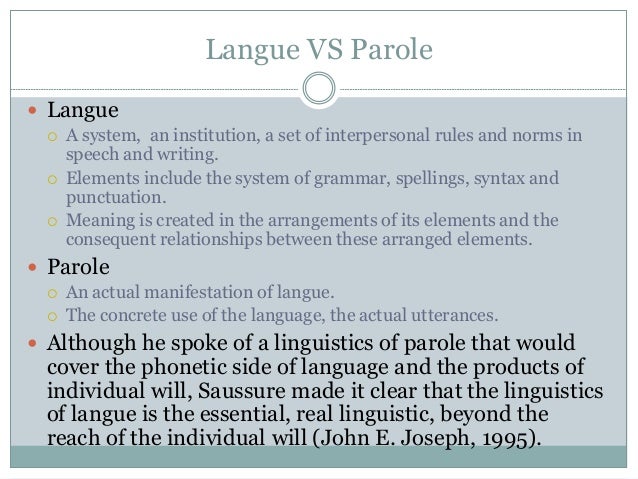
The founder of modern linguistics, Ferdinand de Saussure inaugurated semiology, structuralism, and deconstruction and made possible the work of Jacques Derrida, Roland Barthes, Michel Foucault, and Jacques Lacan, thus enabling the development of French feminism, gender studies, New Historicism, and postcolonialism. Based on Saussure's lectures, Course in General Linguistics (1916) traces the rise and fall of the historical linguistics in which Saussure was trained, the synchronic or structural linguistics with which he replaced it, and the new look of diachronic linguistics that followed this change. Most important, Saussure presents the principles of a new linguistic science that includes the invention of semiology, or the theory of the 'signifier,' the 'signified,' and the 'sign' that they combine to produce. This is the first critical edition of Course in General Linguistics to appear in English and restores Wade Baskin's original translation of 1959, in which the terms 'signifier' and 'signified' are introduced into English in this precise way.
Baskin renders Saussure clearly and accessibly, allowing readers to experience his shift of the theory of reference from mimesis to performance and his expansion of poetics to include all media, including the life sciences and environmentalism. An introduction situates Saussure within the history of ideas and describes the history of scholarship that made Course in General Linguistics legendary. New endnotes enlarge Saussure's contexts to include literary criticism, cultural studies, and philosophy. A comprehensive overview of the development of language studies from the ancient Greeks through modern theorists, this book focuses on determining what the enduring issues in linguistics are, what concepts have changed, and why. Dinneen, SJ, defines the basic terminology of the discipline as well as different linguistic theories, and he frequently compares underlying assumptions in contemporaneous science and linguistics.
General Linguistics traces the history of linguistics from ancient Greek works on grammar and rhetoric through the medieval roots of traditional grammar and its assumption that there is a norm for correct speech. Dinneen marks the beginning of modern linguistics with Saussure's concept of an autonomous linguistic structure independent of socially imposed norms, and he details the theoretical contributions of Sapir, Bloomfield, Hjelmslev, Chomsky, Pike, and others. Dinneen considers the relative merits of the different theories and models, evaluating their claims and shortcomings. A thorough introduction to linguistics for newcomers to the field, this book will also be valuable to linguists, psychologists, philosophers, and historians of science for its evaluations of major theoretical concepts in light of enduring issues and problems in language studies. The fourth edition of General Linguistics provides a comprehensive and accessible introduction to linguistics. The book considers: - semantics and pragmatics - dialect and style - phonetics and phonology - morphology and syntax, with reference both to traditional and current theories - comparative-historical linguistics and linguistic typology - linguistics' relation to other disciplines - the practical application of linguistics - the 2,500 years of linguistic thought that lies behind what we do and think today.
Volume I of Edward Sapir's Collected Works contains the reedition of Sapir's papers and reviews in general linguistics, in the philosophy of language and linguistics (the origin of language; general semantics; the construction of an international auxiliary language), as well as his articles on 'language' and 'dialect' written for the Encyclopedia of Social Sciences. The texts have been reedited and supplied with an introductory study and notes. The introductory studies assess Sapir's contribution to the linguistic study of the various topics dealt with. Volume I also contains a reprint of retrospective appraisals of Sapir's work in general linguistics written by Zellig Harris and Stanley Newman.
The period of 1965 to 1978 was an extremely productive time for U.S. (Russian born) Romance etymologist and philologist Yakov Malkiel whose specialty was the development of Latin words, roots, prefixes, and suffixes in modern Romance languages, particularly Spanish.

Malkiel will be known as the great champion of etymology in linguistics as evidenced by several of the selected essays in From Particular to General Lingusitics. But here Malkiel also moves in several other subfields of linguistics and proves that whatever the subject of discussion is, it is characterized by a tenaciously comprehensive use of evidence. This volume is the first anthology of readings in Yugoslav general linguistics in English.

It contains twenty contributions by outstanding Yugoslav scholars in such areas as comparative typology and contact linguistics, sociolinguistics (including such topics as bilingualism, multilingualism, diglossia, language planning, language policy, translation theory, etc.), psycholinguistics, structural/generative linguistics (phonology, morphology, syntax, and semantics), text linguistics, pragmatics, linguistic semiotics, and the philosophy of language science. The collection should appeal to linguists of all persuasions and specializations.
This book offers a workbook approach to linguistics and provides guidelines for the study of language. It aims to give basic information and to indicate something of the background and development of the more important trends in the subject. Each chapter includes exercises which lead the reader outwards from the information given in the text. A list of suggested further reading and references follows each chapter so that each aspect of the subject may be followed up in greater depth if so desired. The book will be of particular use to first-year university students and to students in polytechnics, technical colleges, colleges of education and further education, and, the authors also hope, to many sixth-formers in secondary schools. It will also be of interest to the general reader who wishes to learn about linguistics.
The academic discipline of linguistics is at a critical stage of development. Whatever consensus there may have been fifteen or even ten years ago is fast disappearing. A process of redefinition is underway, and it is the aim of this volume to contribute to that process, explain why a redefinition is needed, and how it should proceed. In the case of linguistics the subject is also the subject matter.
Many linguists have ignored the problem of definition, simply regarding linguistics as the ‘science of language itself’. What, though, is ‘language itself’? Is it a language, ie English, Swahili? Or, language in a more general sense? The primary goal of a redefinition of linguistics should be to demonstrate that language is not an objective matter.
Linguistics is, and should be, the study of whatever is linguistically pertinent. A linguistics redefined would look at how we interpret and construct our day-to-day communication acts, what views of language are shared by and opposed by societies, and the source and roles that these views play in our living and learning experience. These papers argue the case for such a redefinition more explicitly than has ever been done before in modern linguistic theory. Such a redefined perspective, precisely because it is a perspective, subject to ‘outside’ influence, and in constant dialogue with the perspective of the other human sciences, must be endlessly redefined. The first edition of this major introduction to linguistics rapidly established itself as an important student textbook, and a reference tool for those who already have some acquaintance with linguistics. This second edition has been updated and revised and includes new chapters on syntax and on current developments in generative grammar, as well as new material on the nature of language and on morphology.
This book first provides a comprehensive critical review of the analytic tools and theories of linguistics and systematically surveys major concepts in phonetics, phonology, morphology, syntax and semantics. Having established the basic nature and structure of language, the final part of the book engages some of the wider issues concerning the use of language in speaking and understanding (psycholinguistics), language development in children, social aspects of language (sociolinguistics), and historical language choice. Noam Chomsky has been described as ‘arguably the most important intellectual alive’. His revolutionary work in linguistics has aroused intense scholarly interest, while his trenchant critique of United States foreign policy and his incisive analysis of the role of intellectuals in modern society have made him a prominent public figure.
Raphael Salkie’s timely book introduces the two parts of Chomsky’s work and explores the connections between them. He provides an accessible and up-to-date introduction to Chomsky’s linguistics, laying out his basic assumptions and aims – in particular, his consistent drive to make linguistics a science – and looking at a sample of Chomsky’s recent work. He examines the implications for other fields such as philosophy and psychology, as well as the main challenges to Chomsky’s position.
Raphael Salkie also sets out the key themes in Chomsky’s political writings and his libertarian socialist views. He contrasts the ‘official line’ on US foreign policy – the view that the US is a ‘well-meaning, blundering giant’ – with Chomsky’s carefully argued alternative view. By focusing on Chomsky’s conception of human nature and human freedom the author draws out the links between the two sides of Chomsky’s work, in the belief that both sides raise issues which can profitably be explored. The author also provides a carefully annotated guide to further reading. As an experienced teacher of linguistics with a commitment to political activism, Raphael Salkie is uniquely qualified to present this introduction to one of the seminal thinkers of our time.
Ferdinand De Saussure Linguistic Theory
First published in 1990.