Adobe Acrobat Pdf Distiller
A Create PDF files using Acrobat DistillerPDF HandShake offers the opportunity of using PDF as anexchange format in the printing business. The results on theoutput side, however, depend on the quality on the inputside. So for PDF generation you should follow the instructionsgiven below or communicate the instructions to everycustomer who submits PDF files to you. We recommend touse Acrobat Distiller for PDF generation, and to consult theAcrobat online help.In the following, we briefly discuss the Distiller job optionsthat might be relevant for the PDF HandShake workflows.Note:Please note that some of the Distiller settings describedbelow are best suited for printing only – they may bedisadvantageous for other purposes such as webproduction or re-editing of files using Adobe Acrobat.Start Acrobat Distiller, open Settings Edit Adobe PDFSettings.
And select the General tab to open the dialogshown in. Monochrome ImagesIf you intend to decrease the file size for monochromebitmap images switch Sampling off and selectCCIT Group 4 or Run Length fromthe corresponding pop-up menu.Switch to the Fonts tab to specify the fonts you want toinclude in your PDF file. Shows thesettings that are best suited for printing.Embed All Fonts guarantees that all fonts used inthe original document will be contained in the resulting PDFfile.
This is especially important if you plan to use the PDFfile with PDF HandShake on a different system later. Note that theDistiller software can only embed fonts that are eitherembedded in the PostScript file or available in one of yoursystem’s font locations. TrueType fonts will only beembedded if they are already included in the PostScript file.If you are fairly sure that the fonts you used for documentcreation are available on the system that will be used forproduction, you may uncheck Embed All Fonts. Fig. A.3: Setting up Fonts settingsThe Subset Embedded Fonts When Percent Of CharactersUsed Is Less Than option should be used, and set to 100%, tomake sure that the fonts embedded in the PDF file are reallyused for printing.When printing with the Acrobat plug-in or “pdfprint”, allfonts that are embedded in a PDF file will be sent to theprinter. However, depending on the printer’s defaultsettings, a font from the document might be rejected in casethe printer already has a font of the same name.
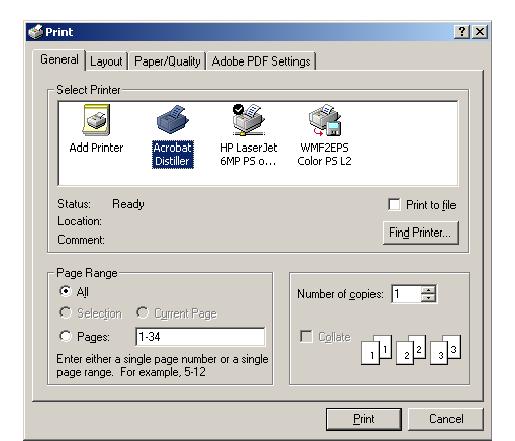
Problemscan arise if the font in the PDF file, e.g. Chicago,is not identical to the printer’s Chicago font.If you use Subset Embedded Fonts When Percent OfCharacters Used Is Less Than and set it to the highest value– 100% – you can make sure that everyembedded font in the document will be assigned a new and uniquefont name (e.g. “CMFONL+Chicago” for a Chicago subset font) thatdoes not coincide with the standard font names on a printer.Note:If you work with Subset Embedded Fonts WhenPercent Of Characters Used Is Less Than and set itto a rather high value you should keep in mind that theAdobe Acrobat cannot re-edit text – in a PDF file – thatuses subset fonts.The Color tabcan be used to apply color settings. We recommend to use the settingsshown in.Choose Leave Color Unchanged from the pop-up menu,as shown in the example, unless you intend to edit the colorsin the PDF document.The profiles pop-up menus for Gray, RGBand CMYK remain grayed out as long as you maintainLeave Color Unchanged.Preserve Under Color Removal and Preserve HalftoneInformation can be checked if required. If your PostScriptfile contains e.g. Halftone information you want to use forlater printing, check Preserve Halftone Information. The“pdfprint” program and the Acrobat plug-in both have anoption that allows to use for printing the halftone informationthat is included in the PDF file.Switch to the Advanced tab as shown in.
Fig. A.5: Setting up Advanced settingsPreserve OPI Comments is only relevant if youare using ImageServer. Both choices are possible: If youare fairly sure that your input document is complete,meaning that all required fonts and high-resolution imagesare embedded, you should uncheck the option. In that caseOPI comments are no longer relevant. If you checkPreserve OPI Comments this would mean that OPIcomments that are already included in your EPSF or PostScriptfile will be included in the PDF file as well; and they willbe resolved by the OPI server later. Fig. A.6: Setting up PDF/X settingsPDF/X Reporting and Compliance Enforcement definesthe PDF/X specification used, what Distiller is todo when it finds files that are not compliant, etc.The PDF/X-1a and PDF/X-3 checkboxes – theseare used to specify which version of PDF/X is desired.
PDF/X-1a isused for device CMYK and spot color workflows; PDF/X-3 isused for color managed workflows.When not compliant – Distiller can either fail a non-compliantjob or it can continue to create a PDF file that is as closeto PDF/X compliance as possible. Using Continue is notrecommended, because it does not create PDF/X compliantfiles when documents do not meet the standard.If neither TrimBox nor ArtBox are Specified – Thespecification of at least one of these boxes is a requirement ofPDF/X (even if the offset values are set to zero.)It is always best to check with the printer to get this settingcorrect, otherwise, leave the offset values set to zero. This willcause the trim box to be set to the page size.If BleedBox is not Specified – The Bleed Box specificationis another requirement of PDF/X.
If it is not specified orDistiller cannot detect the bleed box from the incomingQuarkXPress file (Distiller contains smarts to detect thisinformation, even if the user does not specify it), you canset the bleed box value in relation to the trim box value.Because the size of the bleed box is always greater than thesize of the trim box, the offset indicated here is the distanceoutside the trim box.Default values if not specified in the document– The document output intent is specified in this document. Thisdescribes the intended output condition for the file. ThePDF/X specification allows you to identify these outputconditions in two ways. You can choose either an ICCprofile that describes the device or condition for which thefile is prepared or a characterized printing condition can beused. Distiller has a preference for specifying an ICCprofile.

Based on the profile chosen, Distiller will select theproper characterized printing condition for you.If you do specify a characterized printing condition, it must beregistered in order for it to comply with the PDF/X standard.In addition, the Trapped parameter is specifiedin this section. This parameter is meant to indicate whetheror not the file contains trapping information. In almost all cases,the value of this flag will be Insert False. Unless you aremanually trapping a file, using a trapping plug-in or do notwant the file to be trapped, leave this as Insert False.
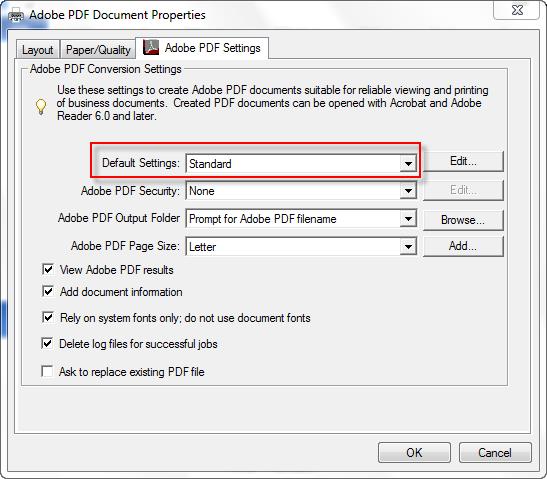
Adobe ® Acrobat ® Distiller is a program used to convert PostScript files to PDFs. Adobe ® Acrobat ® Distiller used to be the only way to create PDF documents. Eventually it became available as a printer driver that allowed users to convert different files to PDF files as a printing function. Even today, any conversion from other software applications such as Word and PowerPoint to PDF uses the Distiller module. Documents are first converted to the PostScript format before being converted to the final PDF file.A Better Alternative to Acrobat Distiller at a Lower PriceThere are many applications outside of the Adobe family that can be used to convert PostScript and other types of files into PDF.
Many of them are cheaper and more user-friendly than Distiller and other Adobe products. One of the best options is.
Thank you for your time! Something wrong, please try again!PDFelement will not only let you convert your PostScript files into PDF but will also allow you to convert over a dozen different file formats to PDF via a simple, user-friendly interface. This application allows you to convert different types of Word, Excel, PowerPoint, eBook, HTML, and image files into PDF files on the same platform.Plus, because documents can be converted in batches, users can also save time when converting their documents.
Another conversion option that can help save time is page-specific conversion, which basically allows you to select specific pages to convert as opposed to the entire document.Apart from conversion, PDFelement incorporates a number of other useful features. It can be used as a basic PDF viewer and editor with multiple options for text editing, spell-checking, and font/paragraph adjustment. It also incorporates OCR, which lets you edit scanned documents.For professional users, PDFelement can be used to organize PDF files with headers, footers, bates numbers, passwords, hyperlinks, bookmarks, watermarks, and other useful items for making documents more professional. It also allows users to extract data in batches, automatically detect form fields, add comments, markups, stamps, shapes, and other forms of annotations, and share the files.Users can also manipulate PDF files in a variety of ways. They can split, extract, and merge PDF pages, which can be useful when creating a new PDF file from different files or reducing the size of bulky documents.Best of all, PDFelement is one of the cheapest PDF tools on the market, with no subscription fees, making it a cost-effective option for individuals and institutions. Thank you for your time!
Something wrong, please try again!How to Use DistillerIntroduction to Adobe Acrobat Distiller:One of the major pros of using Distiller is the high-quality output PDF files. Distiller is capable of reproducing complex text and graphics on documents more precisely than other PDF creators, including Adobe's own PDF Writer. Professionals in design and publishing studios still use Distiller to produce high-quality PDF outputs, even though the functions on Distiller have been largely replaced with Adobe PDF virtual print driver.Distiller is no longer available as a stand-alone download from Adobe.
Adobe Acrobat Pdf Distiller Software
Its functions were mostly integrated into PDF Writer and users can create PDF files by simply downloading and installing PDF Writer on their devices. To create PDF files, users can simply open the document options (in most software applications, including Word, Excel, PowerPoint, and most web browsers), navigate to the printing section, and select PDF Writer as the printer. This will also work with any PostScript file opened via third-party applications.If you have a stand-alone copy of Distiller, you can use it to convert your PostScript files to PDF in a few simple steps.First, save the file you are working on with the extension.ps. Then, launch Distiller, navigate to File Open, and select your.ps file to open it. To change conversion options, navigate to Distiller Job Options, and modify compression and resolution settings for the output file.Once you're satisfied with the settings, select Save and Distiller will convert your PostScript file into a high-quality PDF file. Common Problems with Adobe ® Acrobat ® DistillerDistiller is a great program for converting your PostScript files to PDF from a supported platform.
Do I Need Acrobat Distiller
However, Distiller leaves many less experienced users at a disadvantage, since not many everyday users will be familiar with the settings to produce high-quality PDF files.Standalone PDF creation and conversion programs will usually work just as well, but normally with many additional options to convert. Additionally, users who want to convert PostScript files using Distiller will usually have to purchase the complete version of Adobe Acrobat Professional, which costs a minimum of $14.99 per month on a subscription basis. This is quite expensive, especially for users who don't often deal with PostScript files. In this case, you can discover the best alternatives to Adobe Acrobat here.or right now!